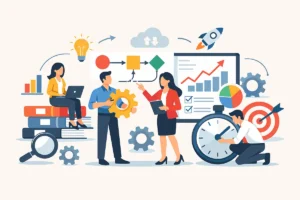
When people think about research and evaluation, they often picture the visible outcomes: evaluation reports, strategic plans, dashboards, and facilitated conversations. What they rarely see are the systems that make those outcomes possible, from workflows and communication channels to project management architecture and learning practices that shape how we work together every day.
It always amazed me how little of this work was ever visible to our clients. And yet it’s the work I’m proudest of for how it contributed to the impact we made. I certainly did not have this perspective when I first started. It emerged slowly through years of asking questions, making mistakes, listening to our team, and paying attention to how people experienced the organization we were building.
Early on, I thought my role was to build our systems. I measured success by trying to solve operational problems (“Is this workflow efficient enough? Is this process easy to follow? Is it scalable?”). What surprised me was realizing how these decisions affected how people experienced the organization every day. I became fascinated by the idea that organizations are living systems that, like the people within them, can grow, adapt, and change over time. That curiosity led me beyond evaluation into disciplines like design, implementation science, organizational psychology, and learning organizations. One such influence was designer Jared Spool, who observed, “Good design, when it’s done well, becomes invisible.”
When organizations are thoughtfully built, people rarely notice the systems behind them. They simply experience an environment where things just… feel good. Collaboration comes naturally, knowledge is easy to find, responsibilities are clear, and learning happens continuously. Over time, I realized we’re constantly shaping our organizations through both the tangible systems we create, such as workflows, onboarding, project management, and documentation, and the less visible ones, like decision-making, communication, learning, and culture. From there, the question I was trying to answer evolved into whether we were shaping BSRI intentionally and how we wanted people to experience our work.
This became the lens through which many organizational decisions were made. Some ideas worked immediately. Others needed refining, and a few failed pretty miserably once we tested them together as a team. Sometimes that meant redesigning our onboarding experience while other times it meant giving more creative control to project teams, de-siloing project folders and files to encourage cross-departmental collaboration, or testing how to better integrate time into our schedules to reflect. These types of changes often had the biggest effect on how people experienced working together.
As our team, projects, and needs evolved, so did our infrastructure. What remained consistent were the questions we asked ourselves along the way and the principles guiding those decisions. Looking back now, I see them woven through nearly everything we built. Our Emotional Design workflow, Learning Organization practices, project management architecture (and so on) may have appeared to address different organizational needs on the surface, but they all grew from our shared belief that organizations create impact by intentionally creating the conditions that enable people to collaborate, learn, adapt, and act together.
Our Designing an Evaluation Operating System guide is an example of this philosophy in practice. Although it focuses on evaluation, it is ultimately about building stronger organizations. Rather than prescribing a single model, it offers questions, examples, and practical ideas that other leaders can adapt to fit their own people, culture, and context.
Every team meeting you facilitate, workflow you introduce, communication norm you reinforce, and opportunity you create for people to learn contributes to the kind of organization you’re becoming. Organizations are living systems that are meant to evolve. So stay curious, start with the principles you want to live by, invite others into the process, and don’t be afraid to experiment. Yes, some ideas will fail… but others will surprise you and lead you in new and better directions.
This is a continuous process because organizations, like the people within them, continue to grow and change. That’s what makes it both so challenging and so rewarding. From my perspective, do not focus on building the ‘perfect organization,’ instead, keep creating better conditions for people to do meaningful work together. That’s where the real fun begins.